Writing Your First Vertical Short Drama Episode
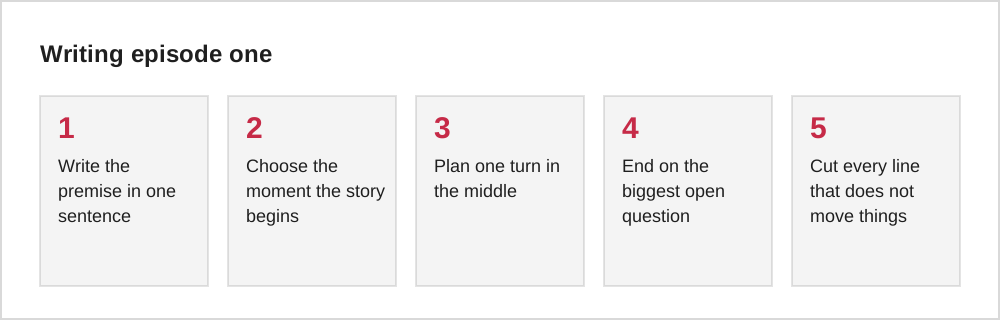
A step-by-step approach to writing a one-minute vertical episode: choosing a premise, structuring the beats, writing tight dialogue and ending on a hook.

Writing a short drama episode is a great exercise in economy. You have about a minute to establish a situation, change it and leave the viewer wanting more. This guide walks through writing a first episode that works on its own and sets up a series.
Start with one clear premise
Pick a premise you can explain in one sentence: "A waitress humiliated at a wedding is secretly the groom's new boss." Familiar tropes help, because the audience fills in the background. Our trope guide lists common starting points.
Begin in the middle of the action
There is no time for slow introductions. Start at the moment of conflict: the insult, the betrayal, the shocking phone call. Viewers learn who people are from how they act under pressure.
Structure the minute
| Seconds | Beat | Example |
|---|---|---|
| 0–10 | Conflict starts | A guest throws a drink at the heroine |
| 10–30 | Stakes are clear | Everyone laughs; her ex-husband joins in |
| 30–50 | Turn | A man in a suit walks in and stops the music |
| 50–60 | Cliffhanger | He bows to her: "Chairwoman, the car is ready." |
This is just one shape; the important thing is a clear change between the start and the end.
Write dialogue for small screens
- Keep lines short enough to read as subtitles in a glance.
- Let each line reveal power, desire or emotion.
- Prefer actions over explanations; show the slap, do not describe it.
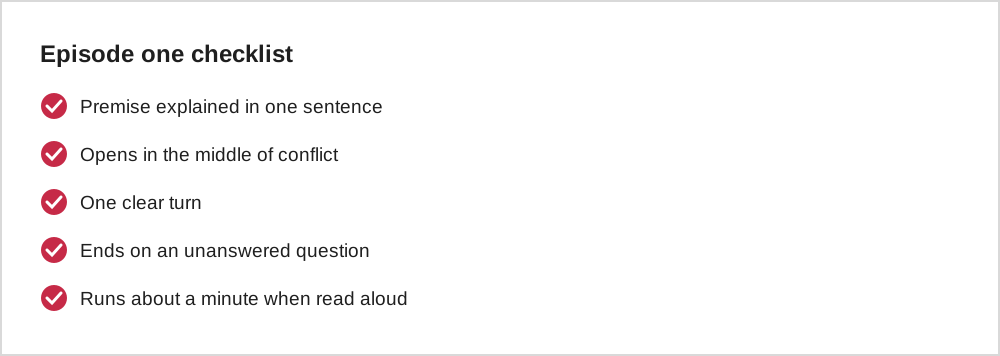
Read your script aloud with a stopwatch. If episode one runs much over a minute and a half, look for lines you can replace with a reaction shot.
End on a question, not an answer
A strong cliffhanger raises a question the viewer badly wants answered: who is this person, what will she do, will he be exposed? Avoid ending on a resolved moment; save the payoff for the start of the next episode. Our guide to cliffhangers that work goes deeper.
Testing your episode
Before filming, test the episode on someone who has not read the script. Read it aloud or act it out quickly and ask them two questions: who has power at the end, and what do they want to know next? If they cannot answer both, the episode needs a clearer turn or a sharper ending.
This simple test catches the most common problems in first scripts: too much setup, a turn that is unclear, or a cliffhanger that resolves itself. Fixing these on paper is far cheaper than fixing them after a shoot.
A sample one-minute outline
Here is how a simple first episode might be planned. 0 to 10 seconds: a woman in a wedding dress waits at a registry office; her phone buzzes. 10 to 25 seconds: a message from her fiancé says he is marrying her sister instead. 25 to 45 seconds: a stranger waiting for his own appointment overhears and offers to marry her, today, for reasons he will not explain. 45 to 60 seconds: she signs, and outside a black car pulls up with a driver who calls him sir.
Every section has one job: set the scene, deliver the blow, offer a choice and hook the next episode. Writing your own outline in this format, with timings, is the quickest way to see whether an idea fits the minute.
Script format basics
You do not need special software to write a short drama script, but a consistent format helps actors and crew. Start each scene with a heading naming the place and time, such as INT. OFFICE, DAY. Write action in short present-tense lines. Put character names in capitals above their dialogue and keep each speech brief.
Mark the final line or image of the episode clearly, since it is the hook. Some writers add an estimated time beside each scene so they can see at a glance whether the episode will run long. If the total is over ninety seconds, cut description first, then dialogue, and only then whole moments.
Common questions
How many episodes should my first series have?
For a first project, a handful of episodes is plenty. Finishing a short series teaches more than starting a long one.
Should I copy popular plots?
Familiar tropes are fine, but write your own characters, dialogue and twists. Copying another show's script or footage is not.
The short version
Choose a one-sentence premise, start in the middle of conflict, build to a single turn and end on an open question. Keep dialogue short, test the timing aloud, and cut anything that does not move the story.