Cliffhangers That Work: Ending Every Episode on a Hook
The cliffhanger is the engine of the short drama. The main types, how to set them up fairly, and how to avoid hooks that feel cheap or manipulative.

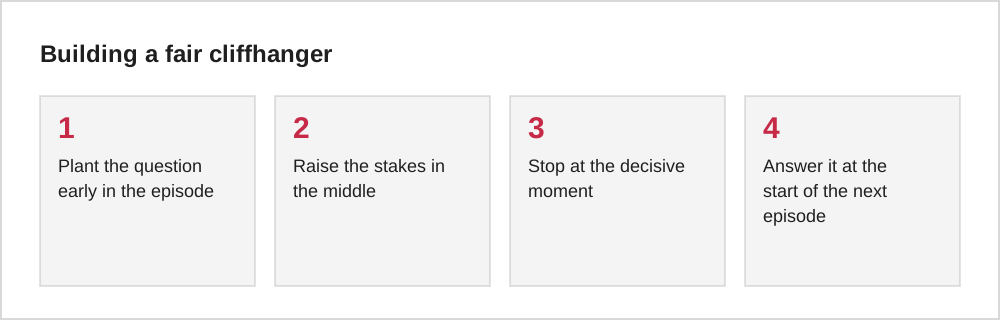
Every short drama episode ends on a hook. Done well, a cliffhanger makes the next episode feel essential. Done badly, it feels like a trick. The difference usually comes down to whether the hook raises a genuine question and whether the next episode answers it.
Types of cliffhanger
| Type | What it does | Example |
|---|---|---|
| The reveal | Uncovers new information | A DNA result is opened |
| The arrival | Someone unexpected enters | The ex-husband walks into the meeting |
| The decision | A character is about to choose | Will she sign the contract? |
| The danger | A threat is imminent | A car speeds towards her |
| The reversal | Power suddenly shifts | The intern is announced as the new owner |
Fair hooks and cheap hooks
A fair cliffhanger raises a question the story will answer honestly. A cheap one creates fake danger that is dismissed immediately ("it was only a dream") or repeats the same hook over and over. Viewers forgive a lot, but repeated cheap hooks erode trust.
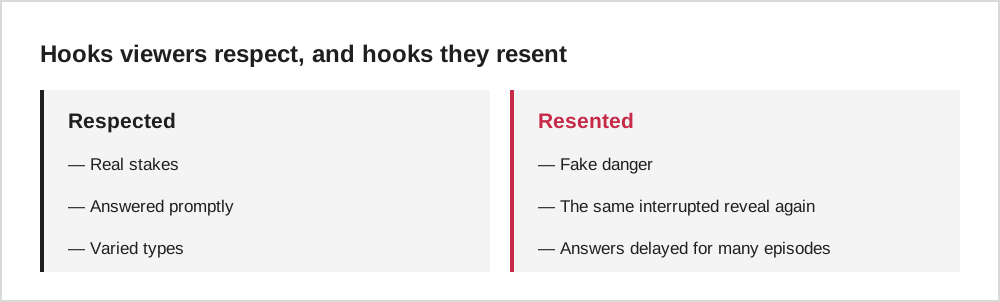
Vary your hook types. A series that ends every episode with someone dramatically walking through a door will feel predictable by episode ten.
Pay off quickly
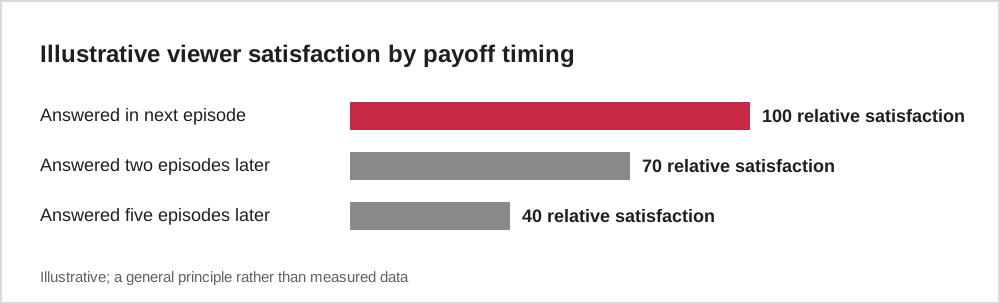
The opening seconds of the next episode should address the hook. If a cliffhanger promises a reveal, show at least part of it. You can open a new question at the same time, which keeps momentum without frustrating viewers.
Hooks without huge budgets
You do not need explosions. Some of the strongest hooks are a single line of dialogue, a look between two characters, or a phone screen showing an unexpected name. These are easy to film and very effective in close-up.
Writing the last line
The last line of an episode carries enormous weight. Strong final lines are short and unambiguous in what they reveal, while leaving the consequences open: a name spoken aloud, a title revealed, a command given. Weak final lines explain too much, or end on a reaction without a reason.
A useful exercise is to write three possible last lines for each episode and choose the one that raises the most urgent question. Read it aloud. If you can imagine a viewer saying "wait, what?" out loud, the line is probably doing its job.
Five cliffhangers, rewritten
Weak hooks can usually be strengthened. She opens the door and gasps becomes stronger when the audience sees who is standing there. A mysterious phone call works better when we hear one alarming sentence. He collapses is more gripping if we already know he has been hiding an illness. The contract is missing gains force if a rival is seen holding it. Someone says I know your secret improves when they name a detail only the heroine knows.
In each case the improvement comes from specificity. A vague hook asks viewers to care about something they cannot see. A specific hook gives them a concrete question that the next episode can answer.
Testing hooks on real viewers
If you are making your own series, show a draft episode to a few people and stop it at the end. Ask what they think happens next and whether they want to see it. If they cannot guess anything, the hook may be confusing. If they all guess the same obvious answer, it may be too predictable.
The ideal reaction is curiosity with a few competing guesses. That means the hook raised a clear question with more than one plausible answer. Keep notes on which hooks get the strongest responses; over a whole series, these notes become a practical guide to what your audience enjoys.
Common questions
Should every episode end on a big hook?
Every episode should end on some open question, but the size can vary. Alternating big and small hooks gives the series rhythm.
Can a cliffhanger work without dialogue?
Yes. A shocked face, an object or a door opening can be enough, especially in vertical close-ups.
The short version
Good cliffhangers raise a real question, stop at the decisive moment and get answered promptly. Vary the type of hook, avoid fake danger, and remember that a single look or line can be as powerful as an explosion.