Why Short Dramas Are So Hard to Stop Watching
Cliffhangers every minute, autoplay, free first episodes and quick satisfaction: the design choices that make short dramas so compelling, and how to stay in control.

Many viewers describe the same experience: you open a short drama app intending to watch one episode, and forty minutes later you are still there. That is not a personal failing. Short dramas are carefully designed to make the next episode feel irresistible. Understanding the design makes it much easier to decide when to stop.
The cliffhanger, every minute
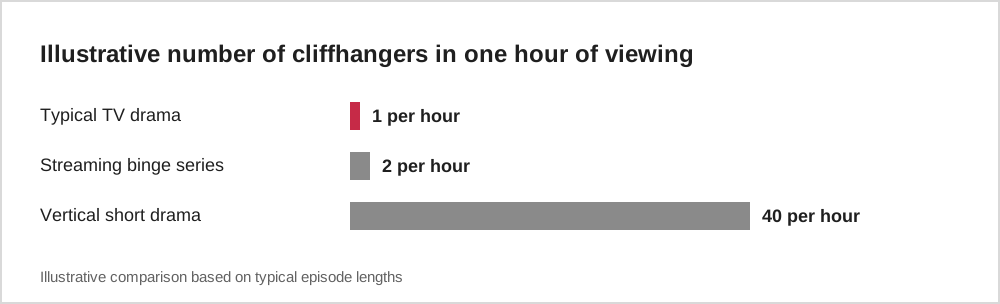
A television episode might end on one cliffhanger an hour. A short drama ends on one every minute or two. Each episode is built to stop at the moment of greatest uncertainty: a slap mid-air, a door opening, a secret half-spoken.
Quick, frequent satisfaction
Short dramas also deliver payoffs at high speed. A rude rival is humiliated, a hidden identity is revealed, a villain gets their comeuppance, often within a single minute. This rhythm of tension and release is satisfying, and it trains you to expect another payoff just one tap away.
Autoplay and the swipe
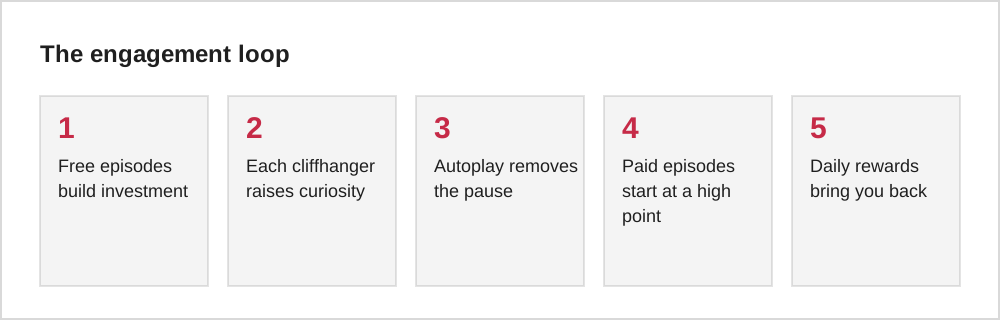
Most apps play the next episode automatically, often after a very short pause. On some apps, a vertical swipe moves you straight to the next episode, the same gesture used on short-video platforms. Removing the decision point is one of the most effective ways to keep viewers watching.
Free episodes and the sunk-cost feeling
Many series make the first episodes free. By the time the paid episodes start, you have invested time and want to know how it ends. That feeling, sometimes called the sunk-cost effect, makes buying coins feel more reasonable than it would have before you started.
If a story is gripping in episode ten, it will still be gripping tomorrow. Stopping on a cliffhanger costs you nothing but a little curiosity.
Staying in control
You do not need to give up short dramas to stay in control. A few habits help:
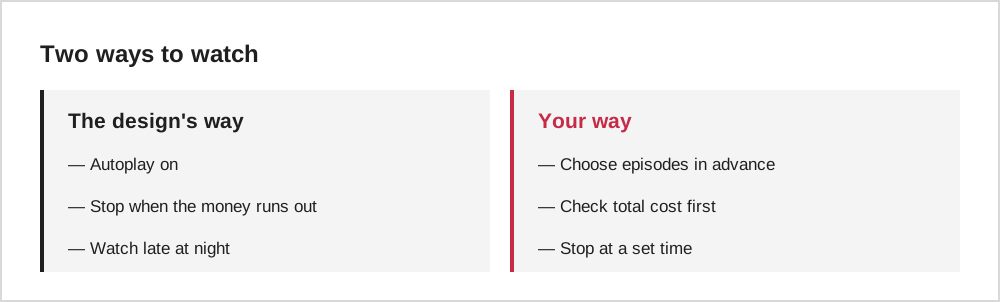
- Decide your stopping point first: an episode number or a time, chosen before you start.
- Turn off autoplay if the app allows it, so each episode is a choice.
- Check the total cost before buying coins, using our coin calculator.
- Avoid watching in bed, when tired brains find it hardest to stop.
Our guide to healthy binge habits goes into more detail.
A note on autoplay settings
Autoplay settings vary by app, and some apps do not offer a way to turn it off. If yours does not, you can still create a pause by locking the phone at the end of each episode, or by watching in short planned sessions. The goal is to make each next episode a decision rather than a default.
Some viewers also find it helpful to watch with the volume low or subtitles on, which makes the experience slightly less immersive and stopping a little easier.
How the format uses reward timing
Psychologists have long noted that rewards which arrive at unpredictable moments hold attention better than rewards that arrive on a fixed schedule. Short dramas use a version of this. Most episodes end on a hook, but the size of the payoff varies: sometimes the next episode resolves the tension in seconds, sometimes it adds a bigger twist. You never quite know which, so the urge to check is strong.
The short length matters too. Committing to another hour of television is a decision. Committing to another ninety seconds hardly feels like one, so the usual moment where people pause and think, the end of an episode, almost disappears. This is not a trick unique to short dramas, but the format concentrates it more than most.
What viewers say helps
People who enjoy short dramas without feeling drained tend to describe similar habits. They choose a series in advance rather than following recommendations late at night. They watch in a fixed slot, such as a commute, instead of opening the app whenever they are bored. Many also keep autoplay off so that each new episode is a deliberate choice.
Another common approach is to treat a series like a book: read the description, sample the free episodes, then decide whether to commit to the whole story or leave it. Deciding at the start removes the episode-by-episode bargaining that makes binges feel out of control. Our healthy binge habits guide collects more ideas.
Common questions
Is it bad to binge a short drama?
Not necessarily. Watching a whole series in one evening can be fun. The question is whether you chose to, and whether it fits your sleep, budget and other plans.
Why do episodes sometimes feel padded?
When a story is stretched across many paid episodes, some episodes may contain little new information. If a series starts to feel like it is stalling, that is a good moment to step away or read a summary of where it is heading.
The short version
Short dramas use frequent cliffhangers, fast payoffs, autoplay and free openings to keep you watching. Knowing the techniques lets you enjoy the format on your own terms: decide when to stop before you start, and let the cliffhanger wait until tomorrow.