Short Dramas vs. TV Series: What Is Really Different?
Pacing, framing, budgets, acting style and how you pay: a side-by-side look at vertical short dramas and traditional television drama.
At first glance, a vertical short drama looks like television cut into small pieces. In practice, the two formats are built differently from the script up. Understanding the differences helps explain why short dramas feel the way they do, and why they appeal to different moods and moments.
Pacing
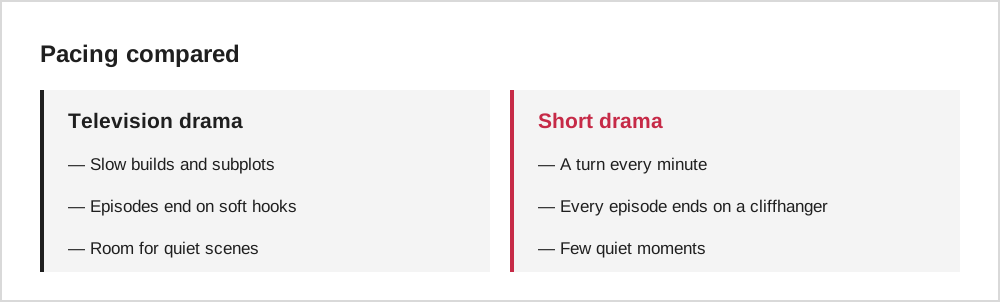
Television drama can spend a whole episode building a single relationship. Short dramas move at a much faster pace, with a reveal or reversal almost every minute. Subplots are minimal, and secondary characters often exist mainly to create obstacles or to react to the main characters.
Framing and staging
Vertical framing favours close-ups and two-person scenes. Wide establishing shots are rare, because they work poorly on a narrow screen. Dialogue is often delivered facing the camera at an angle that keeps both faces in view, and important props are held up near the face so viewers can see them.
Production scale
Short dramas are generally produced on far smaller budgets and much tighter schedules than television series. Industry reporting often describes entire series being filmed in a matter of days rather than months. That speed shapes everything: limited locations, simple lighting setups and scripts that avoid complicated action. Our guide to how short dramas are filmed explains the process.
| Television drama | Vertical short drama | |
|---|---|---|
| Typical shoot | Weeks to months | Often days to a couple of weeks |
| Locations | Many, including large sets | A few, often reused |
| Episode length | 30–60 minutes | 1–2 minutes |
| Story focus | Character depth and subplots | Hooks, reversals, payoffs |
Acting style
Because each moment must register instantly on a small screen, performances in short dramas are often broader: bigger reactions, clearer emotions, dramatic pauses before reveals. This is a stylistic choice that suits the format, even if it looks exaggerated next to naturalistic television acting.
How you pay
Television is usually paid for through subscriptions, licence fees or advertising. Short dramas are commonly paid for episode by episode with coins, or through short-term passes. The pay-per-episode model rewards cliffhangers in a very direct way, because each one is a moment when viewers decide whether to pay for the next.
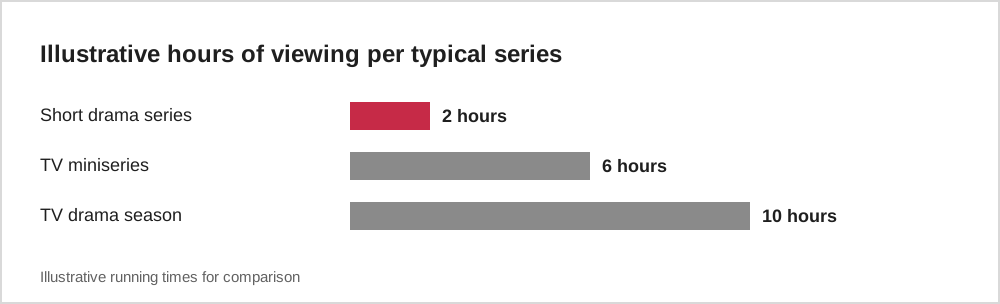
Short dramas and television are not competing to be the same thing. One fits a ten-minute bus ride; the other suits an evening on the sofa.
Which format suits which moment
Short dramas and television serve different moments. A short drama episode fits a queue, a commute or a coffee break, and the whole series can be finished in an evening. Television suits longer stretches of attention, when you want depth, slower character development and visual scale.
Many viewers enjoy both for exactly these reasons. Thinking about when you watch, rather than which format is better, makes it easier to choose and to keep viewing habits balanced.
How writers' rooms differ
A television drama is usually developed over months, with a writers' room breaking stories for a season and each script going through several drafts. Short dramas are often written much faster, sometimes by a small team or a single writer producing a full series outline and dozens of short scripts in a few weeks. The emphasis is on clear premises and frequent hooks rather than subtle character development.
That speed shapes the result. Television can afford quiet episodes that deepen a relationship or explore a side character. A short drama rarely can, because every minute must justify itself. When a short drama does find room for quieter moments, it usually places them between two big events so that viewers do not drift away.
Getting the best out of each
The two formats suit different moods. Short dramas work well when you have a few spare minutes and want an immediate emotional payoff, such as on a bus or in a queue. Television suits longer evenings when you want to settle into a world, follow several characters and enjoy slower storytelling.
Problems tend to arise when short dramas fill the time that would otherwise go to sleep or to longer stories you also enjoy. A simple approach is to give each format its slot: short dramas for commutes and breaks, television or films for the evening. That way the quick pleasures of the vertical format do not crowd out everything else.
Common questions
Are short dramas lower quality?
Production budgets are usually smaller and quality varies widely, but the best short dramas are tightly written and well acted. The format rewards different strengths, such as economy, clarity and pace.
Do actors move between the two formats?
Some do. Short dramas have become a route into acting for many performers, and some established actors have appeared in them too.
The short version
Short dramas differ from television in pacing, framing, production scale, acting style and payment. They are designed for small screens and short breaks, with a reversal every minute and a cliffhanger every episode.