How Short Dramas Are Written: Structure, Hooks and the 90-Second Episode
Short drama scripts follow a tight rhythm: a hook, a turn, an escalation and a cliffhanger, repeated dozens of times. How writers plan a whole series around the minute-long episode.
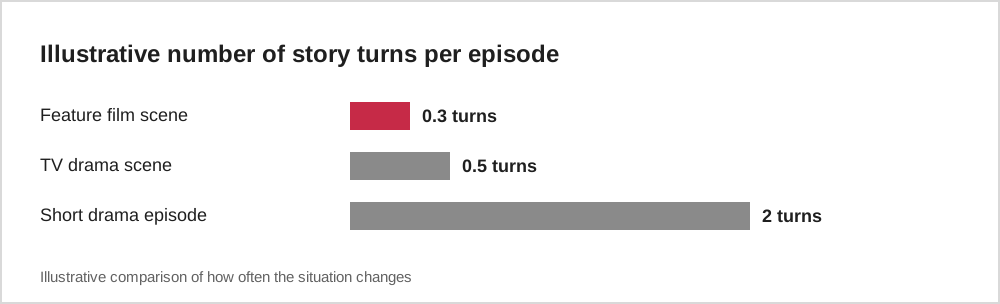
Writing a vertical short drama is closer to writing a serial comic strip than a feature film. Every episode must work on its own in about a minute, and every episode must make the viewer want the next one. That pressure shapes everything from the first outline to individual lines of dialogue.
Planning the whole series first
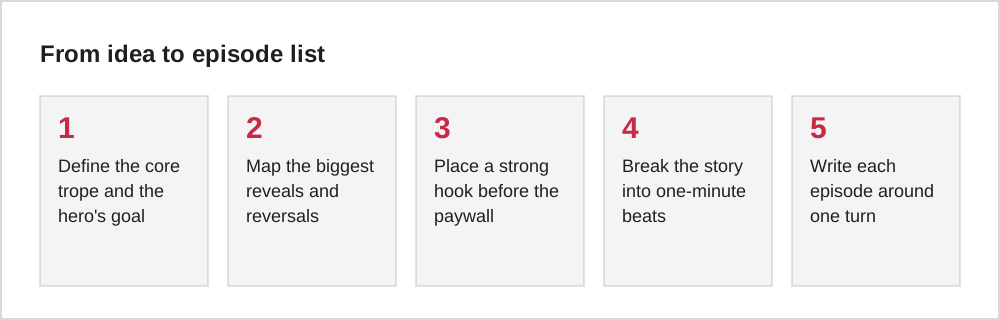
Writers typically start with the big shape: who the hero is, what injustice or desire drives them, and how the story ends. Then they plan the major turning points, often placing the biggest ones where viewers are most likely to decide whether to keep paying.
The anatomy of a single episode
Most episodes follow a recognisable rhythm. Our homepage shows a typical breakdown, and it looks roughly like this:
| Time | Beat | Purpose |
|---|---|---|
| First few seconds | Recap hook | Remind viewers of the last cliffhanger |
| Opening third | Fallout | Show the immediate consequence |
| Middle | Turn | Introduce new information or a decision |
| Late middle | Escalation | Raise the stakes, often publicly |
| Final seconds | Cliffhanger | Stop at the most unresolved moment |
This is a typical pattern rather than a rule, and good writers vary it to avoid monotony.
Dialogue that works on a small screen
Short drama dialogue tends to be direct. Characters say what they want and what they feel, because there is no time for subtext to build slowly. Lines are often short enough to be read as subtitles at a glance. Many viewers watch with low or no sound, so the visual action must carry the story too.
A useful writing test: if the sound were off, would a viewer still understand who has power at the end of the episode?
Reveals and pacing
Writers ration reveals carefully. A major secret might be hinted at for many episodes, nearly revealed several times, and finally exposed at a moment chosen for maximum impact. This pacing keeps tension high without needing complicated plots.
Avoiding repetition
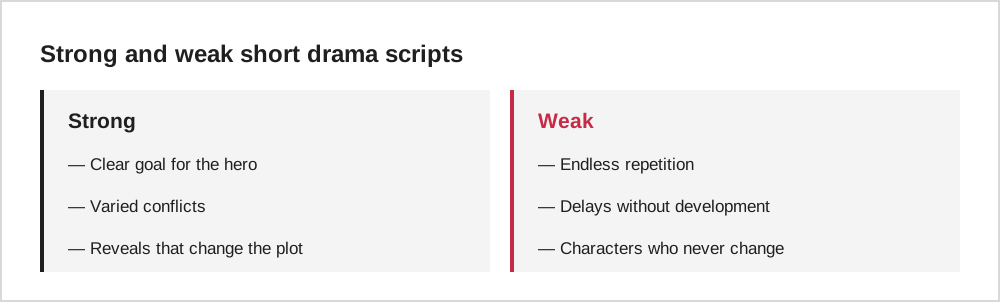
The biggest risk in long series is repetition: the same humiliation, the same interrupted reveal, again and again. Strong scripts vary the type of conflict, move the story to new locations and let characters change.
Common structural shortcuts
Writers working at speed rely on shortcuts that viewers quickly learn to recognise. A phone call can deliver news instantly; an overheard conversation can reveal a secret without a confrontation; a document can prove a claim in seconds. These devices are not lazy in themselves; they are efficient ways to move a story along in a minute.
They become a problem only when overused. A well-written series mixes these shortcuts with scenes where characters make decisions, so that the story feels driven by people rather than by coincidences.
Outlines, beats and episode cards
Many writers start with a one-page summary of the whole story, then break it into acts, then into episodes. Each episode might be described in a single line: what happens, what changes and what the final hook is. Some teams put these lines on cards or in a spreadsheet so they can move episodes around before writing any dialogue.
This planning stage catches problems early. If several episodes in a row end with the same kind of hook, or if a character disappears for twenty episodes, it is visible at a glance. Fixing the outline is far cheaper than rewriting scripts after filming has been scheduled.
Writing for the first three episodes
The opening episodes carry extra weight because they are usually free and decide whether viewers continue. Writers often rewrite them more than any others. The first episode must establish the heroine, the injustice and the promise of the series. The second must raise the stakes. The third often contains the first significant reversal.
A useful test is to describe each of the first three episodes in one sentence. If any sentence is vague, such as the characters get to know each other, the episode probably needs a sharper event. Viewers forgive a lot in later episodes, but they rarely give a slow opening a second chance.
Common questions
Who writes short dramas?
Writers range from professional screenwriters to authors of online serial fiction. Many series are adapted from popular web novels; others are original.
How long does a script take to write?
It varies widely with the length of the series and the production schedule. Because shoots are fast, scripts are often written on tight timelines.
The short version
Short drama writing starts with the whole series and its biggest reveals, then breaks the story into one-minute beats, each with a turn and a cliffhanger. Clear dialogue, visual storytelling and varied conflicts keep long series watchable.